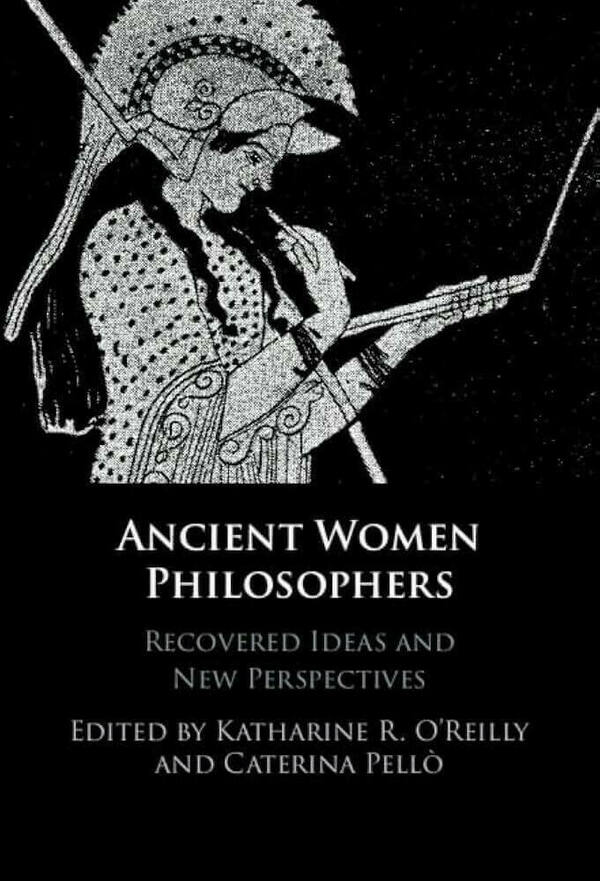
This is an important book. It gathers the fruit of recent research on women in ancient philosophy, and across twelve chapters (all very well-written) offers the reader food for thought on a huge range of topics. We meet scientists and Cyrenaics, Epicurean sex workers and neo-Platonist mathematicians. Two chapters take us outside the standard story of Mediterranean antiquity, and we learn much from these perspective-shifting chapters. For example, Ban Zhao stands out as what, in the Greek tradition, we’d call a phronima: a woman who uses her practical wisdom to write philosophical texts even against the backdrop of difficult cultural headwinds that would seem to make a woman in philosophy an impossibility. While readers might be tempted to skip to the chapters that serve their current research interests, I would strongly encourage taking a look at the whole book: it is more than a sum of its parts, because the recurring themes look different precisely when they’re understood to be recurring.
The introduction will be required reading for anyone working on this topic, and gives judicious coverage of the relevant issues (e.g., why does it matter that these figures are women? Are they doing philosophy in a particularly “womanly” way? How should we manage studying women who are more often the subject of men’s writings than authors themselves?). I particularly highlight figure 1 (8) which provides a flow chart of methodological issues, and guides the discussion of said issues, as invaluable. One important, viewpoint-shifting claim the editors Caterina Pellò Katharine O’Reilly make concerns the way we read philosophy as a series of individual great men vs. communities. Rightly pointing out that we already interpret, e.g., Stoicism, more in terms of school doctrines than individuals, they then suggest we might do the same for other schools—and add that if women belonged to philosophical schools (which we know they did) there’s no reason to presume that they in particular were “passive followers” relative to other school members (17).
While the phrase “double standards” is never used, arguably it guides much of the discussion. For example, the authors discuss the standards of what counts as philosophy—a thorny issue (and not just for the question of women in the history of philosophy). Sensibly, they bring out that the fact there is a tricky border between science and philosophy can be used to exclude women (e.g., by reclassifying women as “intellectuals,” “thinkers,” or “scientists” rather than philosophers), but that same ambiguity doesn’t get used to kick the Milesian natural scientists out of the history of philosophy (12). Similarly, they make the point that while the sources for Presocratic philosophy are plagued by some of the same kind of issues as sources about women, only in the case of women is this routinely viewed as somehow insuperable (13). And, on the concern that women are fictionalized in some sources: “If we were to exclude Socratic dialogues from our teaching and research because Plato fictionalises Socrates. . .or the Analects because they were composed by Confucius’ disciples, the impoverishment that would result would be keenly felt” (14). Indeed.
Chapter one starts the volume with a surprising angle: if asked the question that forms the title of Halperin’s justly famous essay—“Why is Diotima a Woman?”—Frisbee Sheffield suggests we ought to answer “who cares?” Accepting the common view that Diotima was not a historical figure, Sheffield proceeds to argue that Plato thinks gender is unimportant—indeed the use of gendered language is something of a red herring, or meant to make us see that gender is really up for grabs. Sheffield, moreover, takes this to be a good thing. Not all will be persuaded that the pervasive use of gendered language can be explained (or explained away) this way, but even so the chapter nevertheless makes a range of important points about why we might not think the pederastic, all-male educational model is the be-all, end-all for Plato: “The account of eros, with all of its educational aspirations, applies to all human beings (pantes anthropoi, 206c1–2), who are pregnant in both body and soul and enabled by eros in their creative endeavours as they strive to create a life worth living, be that as parents, educators, poets, lawmakers, or philosophers” (26). (I might note that while the description of the assumption that Diotima is a fiction as consensus is generally accurate, it has been problematized by those pursuing a “strong historicity” angle on women in antiquity, to use the phrase put forward in the introduction of the volume—see in particular Nails 2015.)
Brian Black’s chapter also has a “transcending gender” theme—it focuses on Sulabhā in the Indian text the Mahābhārata and shows how she advocates for a sense of enlightenment that transcends gender. Nevertheless, Sulabhā has to confront sexist views espoused by male intellectuals—for me, this dimension of the dialogue between Sulabhā and Janaka is reminiscent of the confrontation between Hipparchia the Cynic and Theorodus the Atheist in Diogenes Laertius (6.97–8). I might underline this chapter was very accessible to this reader, although I have minimal knowledge of philosophy in the Indian tradition; pages 41–3 explicitly addresses the reader more familiar with Greek philosophy, and compares Sulabhā and Diotima.
The third chapter offers a perspective-shifting account of the role of female doctors in ancient medicine. Sophia Connell gathers a range of important pieces of evidence to show that while we lack texts by female doctors/scientists, there are nevertheless plenty of pieces of evidence for women’s work in these fields. This includes archaeological material and the testimony of Plato in Republic 5. In addition, there are references in the Hippocratic Corpus and Aristotle’s works to women’s knowledge of their own bodies; Connell argues—successfully, in my view—that these are not any women’s views, but female experts’ views about such topics as menstruation and gestation. The chapter is filled with fascinating information, but occasionally, in my view, jumps to hasty conclusions: for instance, it’s not clear to me why we should think women developed a view of menstruation before male doctors appropriated it (70), which would seem to assume two discrete phases of the development of these ideas, rather than thinking that they worked collaboratively throughout.
The fourth chapter turns to the notorious Epicurean women. Ancient (largely anti-Epicurean) authorities cast these women, above all, as hetairai, as part of a polemic against hedonism. Kelly Arenson’s chapter does an admirable job of assembling the relevant material, and develops an argument discounting the reports of Cicero and others as slander; but she opens things up in the conclusion, asking the important “so what” question: so what if Epicurean women were hetairai after all? I think this question is very well worth exploring further: to my eye, it seems reasonably plausible that hetairai might have interests in philosophy, initially for reasons of business (since potential elite clients might be very, very charmed by a woman who can hold her own on some fine-grained analysis of the Sorites puzzle).
Katharine O’Reilly turns to Arete of Cyrene—the head of the Cyrenaic school of philosophy, after her father Aristippus and before her son Aristippus the Mother-taught. The latter epithet is highly intriguing, and points out the fact we might be interested in her as a teacher and philosopher. The most interesting suggestion, in my view, is that Arete could not live a Cyrenaic life in the way her father did—“With no access to brothels, public feasts, and other spaces her father is depicted as ‘performing’ in, the possibilities for women to be a Cyrenaic are limited and might come down to the transmission of doctrine” (109)—but the latter, to wit, formalization of Cyrenaic doctrine is no small contribution. Throughout the rest of the volume, we meet characters whose contributions to philosophy were downplayed because they merely lived philosophical lives, rather than writing about them; if that implies an evaluative hierarchy where the most important philosophers are those who write and systematize, Arete would seem to come out as quite significant indeed.
Kate Meng Brassel takes a different (but complementary) approach: she reads the characterization of Megara in Seneca’s Hercules Furens as “a major ethical experiment in female exemplarity,” and one without parallel in Seneca’s prose writings. This reading is prefaced by discussion of the key question of how to position the Stoics’ egalitarian commitments: while Zeno and others advocated for strikingly progressive positions on gender, the dearth of texts written by female Stoics has raised scholarly eyebrows. Perhaps the Stoics simply didn’t practice what they preached? The author’s conclusion is that perhaps we’ve missed who counts as a philosopher, and closely reading depictions of women in literature can shake us out of conventional ways of looking at this question.
Rosemary Twomey turns to some of the most important evidence for women’s philosophical activities in antiquity—the writings of Pythagorean women. These have often been downplayed as too focused on domestic life to be philosophical; but, as Twomey argues, if the household is a viable topic for philosophical analysis in Plato and Aristotle, it can hardly fail to count as a reasonable subject for philosophical theorizing when women talk about it.
The second chapter on Pythagorean women is Giulia De Cesaris and Caterine Pellò’s contribution on Perictione, focusing on On Wisdom. The chapter offers a very satisfying close reading of this key text, and I think prudently avoids making concerns about authorship an end unto itself. The reading positions this work of metaphysics in conversation with, especially, Plato and Aristotle, along with Pythagorean material; I myself would be keen to see further research that then spells out the implications of this for questions like the context of the production of the text.
Anna Christensen and Jana Schulz turn to figures in later antiquity. Christensen’s chapter covers Macrina, whose deathbed arguments against Epicurean views on the soul were preserved by her brother, Gregory of Nyssa; and Schulz turns to Sosipatra and Hypatia, giving a solid rundown of neo-Platonic ideals of femaleness and discussing how each figure squares with these concepts.
Ann Pang-White’s chapter “Reappraising Ban Zhao,” offers a refreshing take on the work of an early philosopher in ancient China. An initial reading of the works of Ban Zhao is likely to leave a modern feminist underwhelmed: her attitude to the patriarchy is largely conciliatory, which led thinkers like the early 20th c. anarchist He Zhen to brand her a traitor to women. Pang-White reminds us that we need to understand each person’s interventions relative to their time period: it’s unrealistic to expect a 2nd century female writer working in a seriously oppressive climate to extol the principles of n-th wave feminism the way today or tomorrow’s philosophers (or TikTokers) might. She does an excellent job explaining the relevant context for Ban Zhao, and how we then might read her position a bit more charitably. This, I think, is a very successful chapter, and one that is inspiring for how we might treat similarly “underwhelming” texts in Greek philosophy (e.g., some of the works by Pythagorean women.)
The volume finishes with Peter Adamson’s contribution on the reception of Plato’s argument for the equality of women in Republic 5, which helpfully brings out the different ways this argument has been understood depending on the fashion of the times. He focuses on Proclus, Ibn Rushd, and Lucrezia Marinella. Particularly fascinating is the repeated invocation of historical women as supporting evidence for the merits of Plato’s argument: as he brings out, these references to folks like the Pythagorean Theano shows “that our present day concern with identifying real women sages was not unprecedented in antiquity” (236).
There are a number of recurring themes in the volume. One key theme is “what counts as philosophy”—Connell, for example, raises this in connection with the relationship between medicine and philosophy (62–4). This is also a key question because of (1) the relative scarcity of texts by female philosophers and (2) the notion of philosophy as a way of life (see e.g., Arenson on Themista and others as living an Epicurean way of life, 91–3; and Twomey’s chapter). Going beyond the question of gender, this parallels the problem with, e.g., the Cynics—another group of ancient philosophers whose contributions to philosophy have been regularly doubted (and who left us very little in terms of writing) but emphatically represent philosophy as a way of life (see esp. Wildberg 2020).
Each chapter in this volume is both a serious work of cutting-edge scholarship and provides a solid introduction to what we generally know about women in these different philosophical schools/contexts. I highly recommend this volume to researchers as well as advanced students. In my experience, there’s something of a “groundhog day” theme in much writing about women in ancient philosophy: while Gilles Ménage wrote Historia Mulierum Philosopharum in 1690, it still feels as if we’re always on day one of “re-discovering” these figures. The publication of this volume, I think, will give us the push we need to make it to day two.
REFERENCES
Nails, Debra. 2015. “Bad Luck to Take a Woman Abroad.” In Second Sailing: Alternative Perspectives on Plato, edited by Debra Nails and Harold Tarrant, 73–90. Helsinki: The Finnish Society of Sciences and Letters.
Wildberg, Christian. 2020. “Cynicism: Or, Philosophy as a Way of Strife.” Oxford Studies in Ancient Philosophy 57: 341–368.