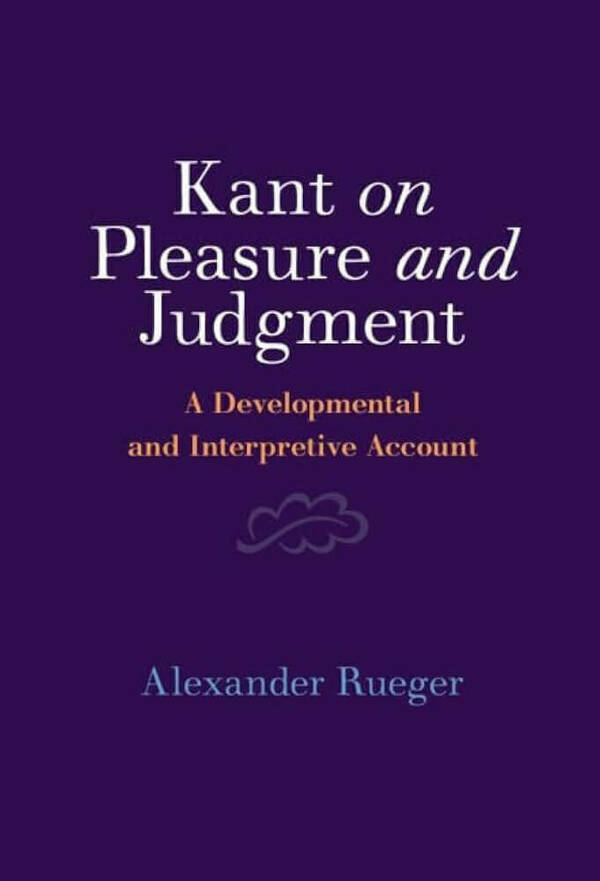
In an important footnote of the Critique of Pure Reason (first published in May of 1781), Kant claims that judgments of taste cannot achieve universality because they have no a priori principle: “The putative rules or criteria [of aesthetics] are merely empirical as far as their sources are concerned, and can therefore never serve as a priori rules according to which our judgments of taste must be directed” (A 21n). At the end of 1787, however, Kant writes to Karl Leonard Reinhold that he has “discovered a new sort of a priori principles, different from those heretofore observed” and that he is working on a book called “The Critique of Taste” (10:514). Kant is of course talking about the Critique of Judgment (hereafter KU), eventually published in 1790, wherein he argues that judgments of taste can in fact achieve universality and that such judgments are related to a special kind of pleasure, namely the pleasure of taste.
What happened between 1781 and 1787 that led Kant to “discover” the a priori principles of taste? In Kant on Pleasure and Judgment, Alexander Rueger seeks to understand Kant’s development during this period and the way in which his views on pleasure relate to those of his predecessors and contemporaries in order to offer new interpretations of many of the central topics in Kant’s third Critique. The book is an impressive mix of engagement with Kant’s historical context and sophisticated readings of the KU that are often developed across multiple chapters. Readers interested not only in Kant’s philosophy of art and beauty, but also his conception of the faculty of feeling, his intellectual development, and his moral theory will find an abundance of material to engage with here, which will certainly occupy scholars for years to come.
There is so much rich material in this book that my aims here must remain modest. After a summary of the book’s contents, I offer some critical remarks on Rueger’s account of the important developments that he believes took place in Kant’s thinking between the publication of the first and second Critiques, and which resulted in the publication of the third.
The book has 9 chapters and begins with a brief analysis of the early reception of the third Critique. Here Rueger considers the reviews of the KU within the first five years of its publication and shows that, in contrast to the early reception of Kant’s previous works, the KU was positively received. The reason for this is that many of Kant’s contemporaries viewed him as offering a theory in line with the preceding Wolffian tradition, according to which beauty, as a perfection, is ‘consensus in variety’ (Zusammenstimmung des mannigfaltigen/consensus in varietate). Rueger uses this to motivate the historical approach taken in the rest of the study: why did the early readers of the KU find it to be in line with tradition when Kant himself, as well as later interpreters, considered it to be so revolutionary? To answer this question, we need to see exactly how Kant’s views in the KU related to the previous rationalist tradition.
Chapter 2 prepares the way for this task by seeking to understand a footnote in the published introduction of the KU (5:197n), wherein Kant supposedly explains the claim that the KU brings his “entire critical enterprise to an end” (5:170). This needs explanation because, as was the case for the second Critique, Kant did not initially plan to write the third; in 1781 Kant envisioned that the first Critique was “the completion of the critical enterprise of pure reason” (A 670). Read retrospectively, the first Critique only supplies the a priori principles of the understanding, and the second Critique those of practical reason. On Rueger’s reading, a third Critique is needed, and the power of judgement should be included in the ‘complete’ table of faculties (see 5:198), because it mediates between the understanding and practical reason by making the concept of purpose or purposiveness applicable to nature (see 25).
The main work of the book begins with Chapter 3, which is the first part of Rueger’s reconstruction of Kant’s theory of the feeling of pleasure and displeasure. Here, Rueger sketches eighteenth-century theories of pleasure prior to Kant, as well as Kant’s own during the 1770s. Rueger focuses on Wolff and Mendelssohn, but also discusses the origin of Wolff’s view in Leibniz and Descartes. What is missing from Rueger’s discussion is a more nuanced reading of Baumgarten: Rueger does not mention that Baumgarten famously drops Wolff’s condition that perfection is linked to the intention or purpose of an author, as scholars such as Clemens Schwaiger have pointed out for some time now (2011, 160). This is significant, because it might explain why Kant does not mention intentions or purposes in the 1770s either (see 45). Nevertheless, the chapter offers an excellent analysis of different models of pleasure: in Kant’s predecessors Rueger finds a “facilitation model” (42) of the origin of pleasure in beauty, according to which beautiful objects bring about pleasure because they make it easier for the mind to perform its original task of having representations that agree with their objects (42–3). But in the Kant of the 1770s, Rueger finds hints of a “stimulation view” (43), according to which pleasure arises via the mind being stimulated to produce ideas. In Mendelssohn, Rueger identifies a “maintenance definition” (49), according to which pleasure occurs when a representation agrees with itself and is therefore a ground for preserving itself or for producing its object (see 48–9). Rueger identifies hints of this view in the pre-Critical Kant as well, but the most important claim in this chapter is that even early on Kant accepted what Rueger calls “the achievement principle” (50), namely that pleasure indicates the achievement of an aim that is specific to a particular faculty.
Chapter 4 reconstructs Kant’s theory of pleasure in the third Critique. Rueger first clarifies that in the KU Kant rejects the idea that pleasure itself is a sensation. I found Rueger’s analysis here fascinating: he convincingly argues (in an elaborate but clear way that I cannot rehash here) that if pleasure itself were a distinct sensation, for Kant, then hedonism would result. Rueger’s conclusion is that we should attribute to Kant a desire or interest satisfaction theory of pleasure: representing an object before its realization is either itself pleasant or promises pleasure because it satisfies the interest of a mental faculty. Key here is that there is no causal relation between judging an object and feeling pleasure on Rueger’s reading: feeling pleasure just is satisfying a faculty interest (Rueger eventually tells us what this interest is in Chapter 7).
Chapter 5 addresses two important consequences of the theory just proposed. First, Rueger argues that his interpretation sheds light on Kant’s claim that judging objects must precede the feeling of pleasure. Rueger makes use of the ratio essendi / ratio cognoscendi distinction here: logically, an implicit judgement takes place when a faculty interest is satisfied, which then involves a feeling of pleasure (ratio essendi), even if it is by means of the pleasure that we first come to know (ratio cognoscendi) that a faculty interest is being satisfied (91). Second, Ruger argues that the theory allows us to infer from the assumed existence of pleasures of taste to the existence of a faculty that is distinct from the other two higher faculties (understanding and reason). Rueger’s argument here involves a conjecture about Kant’s development between 1784 and the third Critique, to which I return below.
Thus far in the book, Rueger has only focused on what led Kant to infer the existence of a higher faculty (of judgement) that has both an interest and an a priori principle, but he has not yet told us what he takes the principle and interest to be. Chapter 6 discusses the principle, which Rueger takes to be a version of the principle of systematicity, that is, the principle of the “thoroughgoing interconnection of empirical cognitions into a whole of experience” (5:183). Rueger argues for a “deflationary” (119) interpretation of this transcendental principle, according to which testable hypotheses of general laws and concepts can be generated which can be either confirmed or denied, but which leaves the presupposition of systematicity itself, on a more general level, untouched. Interestingly, Rueger claims that this is also Fichte’s view (see 119n22), which would have been developed had Fichte written his planned commentary on the third Critique.
Chapter 7 deals with the reflecting power of judgement’s interest. Crucially, the principle and the aim or interest are not identical. Rather, the principle of a faculty is merely the means of attaining the faculty’s aim. Rueger mentions a helpful analogy with practical reason in this context: practical reason’s principle is the moral law, which is a means to its aim of determining the will with respect to its final and complete end (see 126). Rueger then identifies the interest of both the determining and reflecting power of judgement with the free harmony of the understanding and imagination (130). This leads to his interpretation of the deduction of judgements of taste: on Rueger’s view, “the pleasure of taste derives its claim to universal validity from the contingent agreement of a given form, subsumed under a concept of the object, with a form that the imagination could have produced freely” (157). Rueger explains his reading of the ‘nature-as-art’ formula as follows: “nature, unintentionally and accidentally, on occasion generates objects whose forms evoke the pleasure of taste in us, just as if an artist had designed those products of nature for us.” (5) Rueger acknowledges that his reading of Kant on the ‘as if’ in this context is “too literal” (5), and is likely to generate considerable discussion.
In Chapter 8 Rueger investigates questions that arise from this interpretation, such as why he thinks it is preferable to speak of a ‘free harmony’ of understanding and the imagination rather than a ‘free play’, as well as a more detailed account of the ‘comparison model’ sketched in the previous chapter, according to which we compare an object to forms that the imagination could have freely produced. This model needs to be supplemented because not all objects are given, rather in the case of artistic creation, for instance, the object is first produced. On Rueger’s view, the imagination produces, through symbolization, free forms, which can then be compared to given forms.
In Chapter 9 Rueger discusses the transition from nature to freedom as Kant discusses it in both the ‘aesthetic’ and ‘teleology’ of the KU. Rueger therefore dubs Kant’s two accounts of the transition in these parts the “logical transition” and the “aesthetic transition” (188), but he states explicitly that he treats them only briefly and has “little to add” (189) to the literature. What is novel in Chapter 9 is Rueger’s account of a transition he sees as taking place between the first Critique and the Groundwork, on the one hand, and both the second and third Critique, the Religion, and the Metaphysics of Morals, on the other. This is the first of two views I would like to critically discuss.
Against Paul Guyer, who is Rueger’s main foil in the entire book, and who claims that Kant places stronger emphasis on moral feeling in the later works because he views Kant as wanting to move beyond the “austere” philosophy presented in the earlier works, Rueger sees a different transition as having taken place. In particular, Rueger claims that Kant shifted his “views about human beings” (189) during this time: whereas in the first Critique and the Groundwork Kant viewed the possession of understanding and reason (as spontaneous faculties) as proving that human beings belong to the intelligible world, are free, and are subject to moral obligation, Rueger argues that in the later works Kant makes a distinction between beings with mere “humanity” and those with “personality”; put differently, between merely rational beings (vernünftige Wesen) and intelligible beings (Vernunftwesen) (see 6:418). The difference is that beings with mere humanity are still subject to natural necessity, and the possession of reason and the understanding are not sufficient for being independent of nature, free, and subject to moral obligation. As Rueger helpfully puts it with the help of a choice passage: a maximally rational being could still be morally dead (204 and see 6:400). For personality we additionally need a capacity to be receptive to the moral law, namely what in the Metaphysics of Morals Kant calls “moral feeling” (see 6:399–400). Rueger backs up his suggestion with support from various lecture notes and other published writings, and I find it plausible. Especially when one considers that many of the early reactions to the first Critique and the Groundworktook issue with Kant’s sharp divide between the phenomenal and noumenal self, it would not be surprising if Kant shifted his view in the way Rueger suggests, even if I think he and others (such as Guyer) go too far in claiming that Kant places more emphasis on feeling within his philosophy in the later works as opposed to the earlier.
This brings me to my final critical remark: Rueger argues that Kant was able to claim there are a priori principles of taste in 1787 when he denied this in 1781 because of an important change that took place in Kant’s development during this time. The change is nothing less than Kant’s discovery of autonomy in the early 1780s, which is linked to other important innovations in Kant’s moral philosophy. What is relevant for Rueger’s purposes is that Kant’s views about the relationship between moral judgment and moral motivation changed drastically in the runup to the Groundwork: in the first Critique, for instance, Kant claims that without “promises and threats” (A 811), “the majestic ideas of morality are, to be sure, objects of approbation and admiration but not incentives for resolve and realization” (A 813). As Rueger notes, this view changes in the Mrongovius II lecture notes on moral philosophy from 1784/5 and in the Groundwork, where we find Kant’s mature view that reason induces or causes a feeling that has motivational power on its own, namely Kant’s famous feeling of respect (Achtung) for the moral law. Although Rueger does not discuss it, Kant’s first mention of this feeling occurs in the Feyerabend lecture notes on natural law from 1784 (see 27:1326–7). With the idea of a feeling that can be induced, produced, or self-wrought (selbstbewirkt, see 4:401n) by reason alone, Rueger claims that an important obstacle is now removed for the possibility of universal judgments of taste: on Rueger’s reading, with the idea of ‘respect’ Kant now has a way of acknowledging the possibility of a feeling that can serve as an incentive without threatening to ground moral judgment on feelings, as Kant takes the moral sense theorists to have done. My issue with Rueger’s “conjecture” (102) here, as he puts it at various points in the book, is that it is not clear to me how a universal feeling for beauty could threaten “the ‘purity’ of morality” (102), as he suggests Kant thought prior to 1784. After all, Kant eventually calls the pleasure involved in judgments of beauty “disinterested” (see 5:205). Furthermore, and as Rueger himself acknowledges, Kant granted the possibility of universal feelings even in the 1770s, namely universal feelings of pleasure in the good (see 28:249), and Kant rightfully held such feelings to be compatible with the purity of morality because such feelings are subsequent to moral judgment, not the ground of it. Thus, it is not clear to me why Kant’s discovery of the feeling of respect opens any new ground for a universal pleasure of taste in the way Rueger suggests.
I take this to be a somewhat minor point, especially since Rueger’s more general point is correct, namely that the important developments in Kant’s thinking that led to him writing a third Critique are likely linked to innovations in his moral philosophy, as scholars like Heiner Klemme have claimed in the past (2010). Overall, the book is a sophisticated and welcome contribution to the growing body of literature that seeks to understand Kant’s philosophy in its historical context and is to be recommended to Kant scholars of all varieties.
REFERENCES
Clemens Schwaiger. Alexander Gottlieb Baumgarten: Ein intellektuelles Porträt. Frommann-Holzboog, 2011.
Klemme, Heiner F. ‘The Origin and Aim of Kant’s Critique of Practical Reason’ in Kant’s Critique of Practical Reason: A Critical Guide. Edited by Andrews Reath and Jens Timmermann. Cambridge University Press, 2010, pg. 11–30.